Contents
- Establish the source before attributing liability
- The neighbour is not automatically liable
- Send a clear notification and preserve the response
- Separate stopping the leak from restoring your apartment
- What evidence supports a compensation claim?
- Notify insurers without confusing coverage and liability
- If you rent the affected apartment
- Clarify the legal position behind your water-damage claim
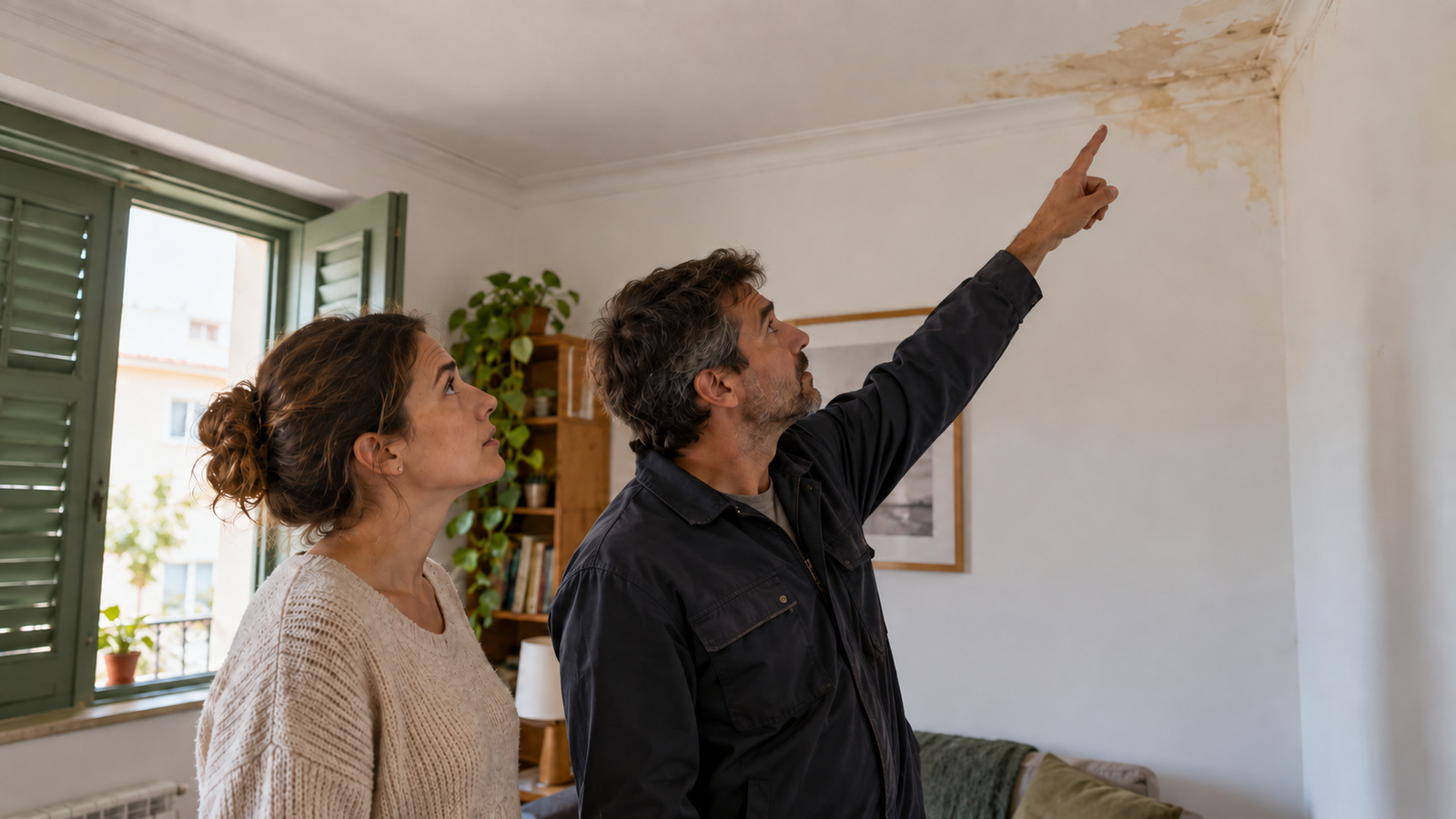
Water appears on your ceiling and the apartment above seems the obvious source. Before sending its owner a repair bill, separate three questions: where the water came from, who had the relevant duty over the source, and what loss the incident caused. The position of a stain alone does not establish legal responsibility.
This guide concerns an apartment owner's response to water damage involving a neighbouring unit or shared building installation. An active leak first needs safe technical intervention. If there is immediate danger, contact the appropriate emergency services and keep away from affected electrical equipment. Preserve evidence as soon as it is safe to do so.
Establish the source before attributing liability
Ask a suitably qualified professional to identify the probable source, the tests performed and any remaining uncertainty. A private appliance or connection, a shared pipe, a roof or a covering terrace can lead to different legal positions. Water may travel through the building before becoming visible in your apartment.
Obtain a dated report with photographs and the locations inspected. If access to another unit is needed, request an agreed inspection and keep the response. A suspected claim against a neighbour is not permission to force entry into their home.
Civil Code Article 1421 identifies common parts, including roofs and covering terraces even where allocated to a fraction's use, and general water installations. A pipe's location inside an apartment does not, by itself, settle whether it belongs to that fraction or to a common installation. Check the constitutive title and technical evidence together.
The neighbour is not automatically liable
Civil Code Articles 483, 487 and 493 provide relevant civil-liability rules. The general rule requires an unlawful infringement, fault, damage and the necessary causal connection. The applicable burden of proof may change where a statutory presumption applies.
Article 493(1) addresses a person who has a movable or immovable thing in their control with a duty to supervise it. Where its conditions apply, that person can be responsible for damage caused by the thing unless they prove the statutory defence: no fault on their part, or that the damage would have occurred even without fault.
That is not automatic liability for whoever owns the apartment upstairs. Ownership, occupation, actual control, the defective item and the relevant duty all need examination. Nor does a presumption of fault remove the need to establish that the relevant source caused the damage claimed.
If the problem comes from a common part, involve the condominium administrator. Responsibility for repairing the source and responsibility for damage already caused must each be assessed. The administrator's management role does not automatically make that individual personally liable for every building defect.
Send a clear notification and preserve the response
Notify the neighbour or relevant owner and the administrator, identifying what is known and what remains unconfirmed. State when the problem appeared, where it is visible, whether it is continuing and what inspection or protective action you request. Keep the messages and evidence of delivery.
Use a short chronology rather than a series of unconnected photographs. Record earlier incidents, previous notices, visits, tests and any repair said to have stopped the source. Ask for the inspection findings and scope of the proposed repair in writing.
If a shared installation or common building defect requires prompt action, the guide to urgent condominium repairs addresses the administrator's role and the limited circumstances in which an owner can arrange common-part repairs. It does not replace the investigation needed to establish the source of your loss.
Separate stopping the leak from restoring your apartment
Keep separate records for investigating the cause, stopping the source, drying the affected area and restoring damaged finishes or belongings. A quotation for repainting does not necessarily show that the leak has been eliminated. Ask the professionals to explain the sequence they recommend and document the condition before each stage.
Where immediate protective work is needed, record why waiting would have increased the damage. Keep the call-out report, photographs, itemised invoice and proof of payment. If a component is removed, ask whether it can be retained safely or adequately documented before disposal.
Avoid presenting an upgraded kitchen or a complete refurbishment as automatically recoverable because a leak occurred. Under Civil Code Articles 562 to 566, restoration and compensation depend on the legally relevant damage and causal connection. The appropriate measure can require assessment of the pre-incident condition, repair options and supported losses.
Need help with this?
Our legal team handles this process end to end. Get a clear assessment and a concrete plan.
Request a legal opinion on water damageWhat evidence supports a compensation claim?
Prepare a file that lets someone distinguish cause, responsibility and amount:
- Dated photographs and video showing the location and development of the damage.
- Technical findings, inspection access records and details of the suspected source.
- Notices to the neighbour, owner and administrator, with their responses.
- Separate quotations, invoices and payment evidence for investigation, protection and restoration.
- Evidence of damaged belongings, temporary accommodation or lost income, where those losses are claimed.
- Relevant ownership documents, condominium records and insurance correspondence.
Lost rent or temporary accommodation costs are not payable merely because they appear in a demand. Explain why each loss resulted from the incident, its amount and the period involved. An insurer's assessment, a contractor's quotation and a legal finding of liability perform different functions.
Notify insurers without confusing coverage and liability
Notify your insurer promptly using the policy's procedure and time limits. Ask which cover is being considered, what inspections are needed, whether proposed works require agreement and how the insurer wants emergency expenses documented. If the neighbour or condominium has relevant insurance, request the claim reference and contact details where available.
The compulsory fire insurance addressed by Civil Code Article 1429 is not a promise that every water-damage incident is insured. The actual policy, insured risks, exclusions, limits and facts need review. An insurer's refusal does not, by itself, decide whether another person owes compensation under civil law.
Keep a record of amounts already paid and any settlement or release requested. The remaining claim needs to account for those payments; do not sign away an unresolved claim without understanding the terms.
If you rent the affected apartment
Notify your landlord as well as reporting the leak to the appropriate building contacts. The landlord's repair obligations, your belongings and a possible third-party damage claim can involve different rights. The guide to landlord repairs and tenant rights addresses the residential lease route. This owner-focused guide is not a basis for withholding rent.
Clarify the legal position behind your water-damage claim
Send the technical findings, photographs, incident chronology, notifications and itemised losses. A written legal opinion can assess the relevant responsibilities, the evidence still needed and the available route for pursuing the dispute. Flag any continuing damage or formal deadline at the first contact.